

Avre Friday Briefing #61
Batch No. 4 is live

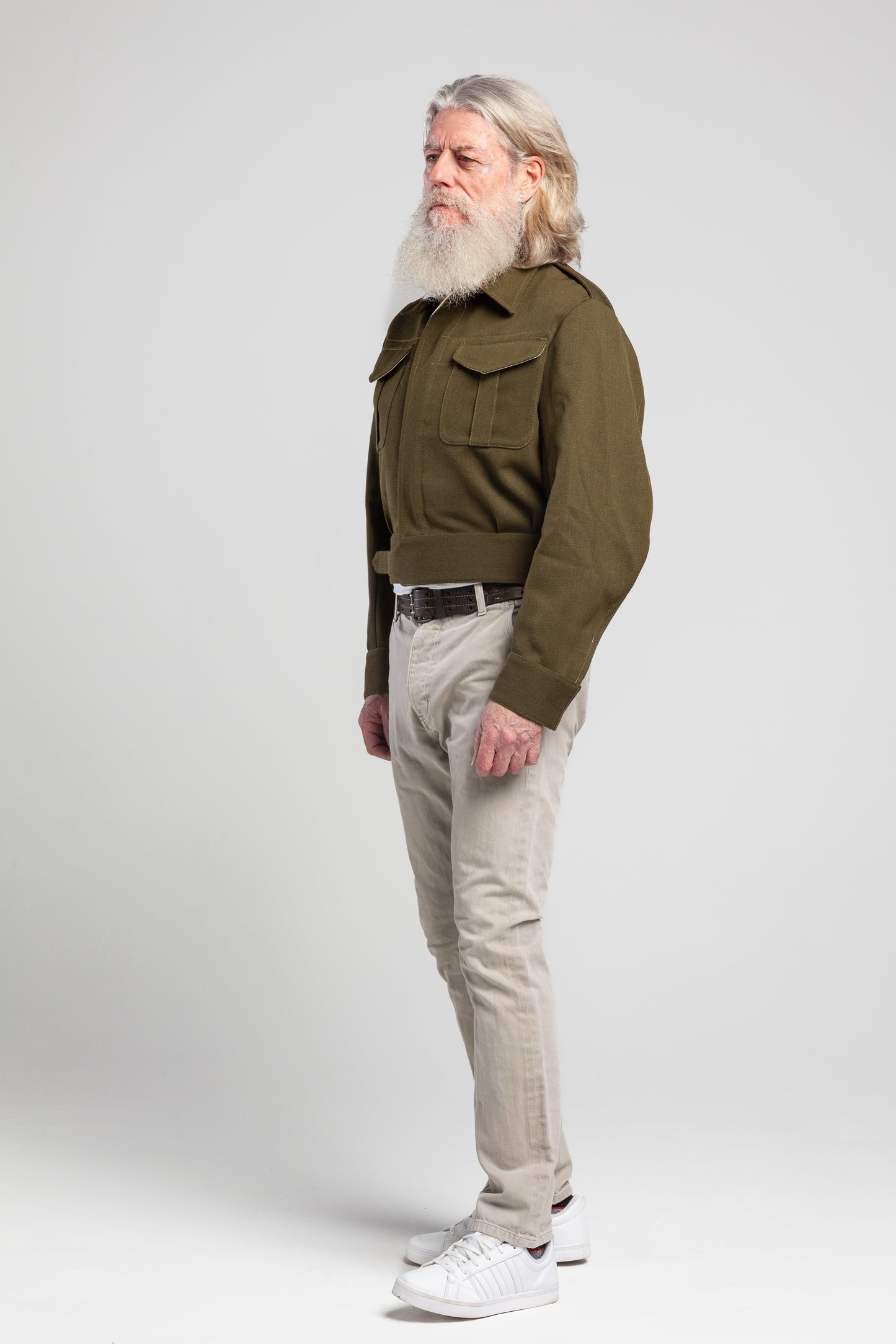
The 1940 Pattern Battledress Blouse is now live. We're offering it initially as the Officer's cut — fully bespoke and fitted to you, 100% Merino wool serge outer and partially lined with authentic WWII parachute silk. It's limited to 100 individually numbered pieces.
Parachute silk
Silk was rationed during the war. Parachutes were expensive to produce and precious — they carried men into occupied Europe; into chaos and into an uncertain future. After the war, a lot of that silk survived.
Families kept it, often folded into drawers or stored in lofts, and eventually it got passed down the generations. And then, across Britain and Europe, it started appearing in wedding dresses. Fabric that had floated down through anti-aircraft fire was repurposed into something that that represented peace and new beginnings.
The Imperial War Museum holds examples, and when you see them the logic is obvious — the material was scarce, beautiful and already had a story attached to it.

The marriage of Bertram Charles Jacklin to Elizabeth Norah Castle who is wearing a wedding dress made of parachute silk which she made herself. 1942.
At Avre we're passionate about finding and telling stories. With each of our batches we tell the story of the men and women who wore the originals. Which is why, when we were thinking about what should line the collar of Batch No. 4, original parachute silk felt like a great choice. What better material to tell a story than a parachute. It's instantly evocative.
The material we use inside each jacket is connected to the Normandy invasion — preserved for over 80 years, and now carefully cut and sewn into the collar of 100 individually numbered garments. A physical fragment of one of the defining moments of the last century, hidden just inside the collar of a jacket built to last another 80 years.
The VC recommended by the enemy
Last week we wrote about Operation Chariot and the 265 Commandos of the St Nazaire Raid. One story from that night deserves a special mention.

Sergeant Thomas Frank Durrant of the Royal Engineers was on Motor Launch 306 when it came under sustained attack. The bridge was wrecked and the boat was on fire. Casualties were mounting. Durrant stayed on deck and kept working his Lewis gun against a German destroyer at near point-blank range — a lightly armed wooden launch against a fully armed warship. He was wounded multiple times but refused to stop.
At one point the destroyer drew alongside so closely the two vessels were almost touching. Durrant carried on.
ML 306 eventually surrendered. Durrant by that point was catastrophically wounded. Kapitänleutnant Paul, the German officer commanding the destroyer, was so struck by what he'd witnessed that he later spoke to the British about it directly. His testimony formed part of the recommendation for Durrant's Victoria Cross.
Courage so undeniable that even the other side had to acknowledge it.
Durrant died that day aged 23. He was awarded his VC posthumously, in part due to the account of the German officer.