

Avre Friday Briefing #53
From British Decks to the Essex Class — the history of the Aircraft Carrier
The aircraft carrier’s story begins not with the United States, but with British experimentation at sea during the First World War. After early trials of aircraft taking off from ships, the Royal Navy pushed the concept forward with HMS Furious, on which a successful landing was made in 1917 while the ship was underway. Commander Dunning landed his Sopwith Pup on the forward deck while dodging the ship's superstructure. It was a harrowing feat that proved a full-length deck was a necessity for safety.

HMS Furios in 1918, after being fitted with an aft landing deck
This was followed by HMS Argus, completed in 1918 - the first true carrier with an unobstructed, full-length flight deck. That mattered because it turned the idea from an improvised launch platform into a genuine floating airfield.

HMS Argus at sea during Operation Torch in late 1942
The Americans followed the British lead: USS Langley, commissioned in 1922 after conversion from the collier Jupiter, became the U.S. Navy’s first aircraft carrier, and USS Ranger, commissioned in 1934, became the first U.S. carrier designed and built from the keel up as a carrier.

USS Langley (CV-1) underway in June 1927
By the Second World War, the carrier had replaced the battleship as the decisive capital ship in the Pacific, and the U.S. Navy scaled the idea into the powerful Essex-class.
USS Intrepid (CV-11), the hero ship behind Batch No. 3, was one of that class. She was commissioned on 16 August 1943 at Norfolk Naval Shipyard and went on to become one of the war’s hardest-fighting fleet carriers, embodying the moment when the aircraft carrier had fully come of age: a ship built not around guns, but around the striking reach of embarked aircraft. In that sense, Intrepid was the culmination of a line that began with British deck experiments and ended with America mastering carrier warfare on an industrial scale.

Intrepid off Hunter's Point in June 1944, her deck loaded with aircraft to be transported to the Pacific Theatre

Batch No. 3 shoot
Last month we shot Batch No. 3 at two very cool London locations - The Bike Shed and Blues Kitchen, both in Shoreditch, East London.


Vat 01
There's a fair amount of work that goes in to producing a rare whisky. From crafting the blend itself, to researching the story, to designing the packaging and labelling. Every element needs to work together to feel like a coherent whole.
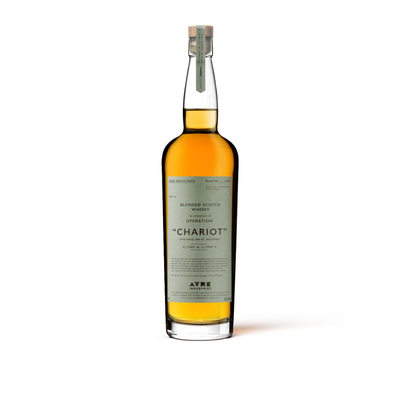
This week we thought we'd share the inspiration behind the label we created for Vat 01. The edition itself honours the 265 Commandos and Royal Navy personnel who embarked on Operation Chariot in March 1942, many of whom never returned. The operational orders for the mission have been preserved and it was this document that gave us the idea for our label.

Operational orders for Operation Chariot, 28th March 1942
Only a very small number of full written operational orders for the raid were produced. Almost all of them went forward with the raiding force and were lost with it. But one set survived, not because it was protected or hidden, but because the officer carrying it never boarded. Whether it was a reassignment, a delay or something else isn't entirely clear — accounts differ. Whatever the reason, he held onto the sealed orders ashore rather than destroy them, on the assumption they might still be needed. Because nearly every other copy sailed that night and didn't come back, his decision unintentionally preserved the only complete surviving set of orders. They're now held in the naval archive.

You can download a PDF of the operational orders here.
More on the whisky next week.
Latest from WW2 HQ
Walking the Ground: Lanzerath Ridge — how 22 men held up a Panzer column
James and Al are in Lanzerath, Belgium, tracing the advance of Kampfgruppe Peiper — the armoured spearhead of Hitler's Ardennes offensive in December 1944. The story at the centre of it is extraordinary: Lt. Lyle Bouck and 22 U.S. intelligence troops dug in on Lanzerath Ridge and held off repeated attacks by a much larger German Fallschirmjäger force, blocking Peiper's panzers for crucial hours. That night, a furious Peiper stormed into the Café Scholzen demanding to know how a single American platoon had stopped his entire column.
One of the most remarkable small-unit actions of the whole war. Well worth a watch.